
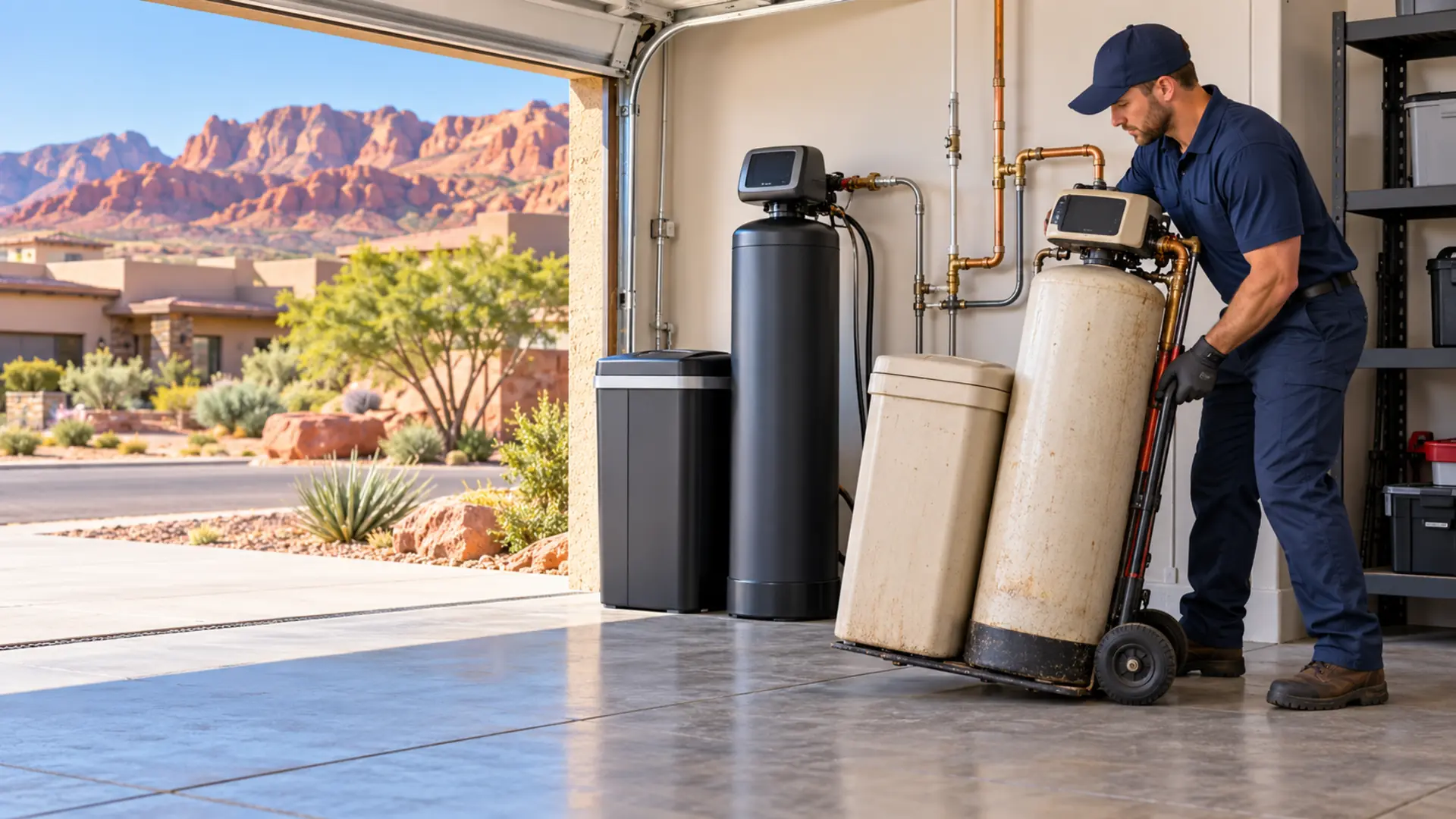
Water softener replacement in St. George, UT
Water softener replacement in St. George, UT may be worth considering when an assessment finds that repairs are impractical or the existing system no longer meets your household's needs. It is not the only option—a repairable valve, a salt bridge, or a single worn component may not require a new system at all.
- Compare repair, component replacement, and full replacement
- Sizing based on measured hardness and actual demand
- Installation by our local water-treatment partner
Request a Water Softener Replacement Estimate
Inquiries routed to our local water-treatment partner for a site-specific assessment.
When is replacement actually the right call?
Age alone does not establish that a softener needs replacement. A repairable valve, a programming issue, a salt bridge, or another component problem may not require a new system. Full replacement may make sense when equipment condition, parts availability, repeated failures, repair expense, or changed household requirements justify it. An assessment should compare realistic options and their total costs—not steer you toward buying a new system by default.
Repair may suffice
A single failed part or salt bridge can often be fixed without a new system.
Size to your home
Replacement sizing uses measured hardness and demand, not bedroom count alone.
Compare the quote
A written scope should list what is included, reused, and removed.
Compare your three main options
Before committing to a new system, it helps to compare repairing the existing unit, replacing a single component, and replacing the complete system. Each has a different trade-off.
| Option | When it may make sense | What needs inspection | Potential limitations | Questions to ask about cost & warranty |
|---|---|---|---|---|
| Repair the existing system | A single component failed, or a salt bridge or programming issue is the cause. | Valve, seals, injector, brine draw, and resin condition. | Other parts may still be near end of life; repair does not renew the whole system. | Is the repair warrantied? How does its cost compare to replacement? |
| Replace resin or a control valve | The tank is sound but the resin is exhausted or the valve has failed. | Part compatibility, tank condition, and whether the rest of the system is sound. | Labor can be a meaningful share of the cost; replacing one part does not renew the whole system or its warranty. | Is the replacement part compatible? What warranty covers the new component versus the rest? |
| Replace the complete system | Repeated failures, unavailable parts, or changed household needs make repair impractical. | Hardness, demand, plumbing, drain, power, space, and which branches get soft water. | Higher upfront cost; may require connection or drain modifications. | What does the equipment warranty cover versus the labor warranty? Is removal included? |
Do not assume resin or valve work always costs nearly as much as a new softener, or that every provider offers component rebuilding. Compatibility and pricing should be confirmed during the assessment.
Not sure whether to repair or replace?
Share what your system is doing and our local water-treatment partner can compare the realistic options and their costs.
Signs that warrant an assessment
These are reasons to request a diagnosis—not proof that replacement is necessary. Measuring hardness before and after treatment can help evaluate whether the softener is still performing.
Recurring hardness breakthrough
Soft water returns to hard, even after regeneration. This can point to exhausted resin, a bypassed valve, or incorrect programming—not automatically a failed system.
Repeated breakdowns
Frequent service calls suggest the unit is reaching the end of its serviceable life, though a single recurring part may still be repairable.
Leaks or damaged equipment
A cracked tank or persistent leak may require replacement, while a fitting or valve leak may be repairable. Note where the water appears.
Unusual salt or regeneration water use
A sudden change in salt consumption or regeneration water can signal a valve or programming issue. Whether it means replacement depends on the cause.
Changed household demand
A larger household or higher-flow fixtures may outgrow an older, smaller system. Sizing should be rechecked against actual demand.
Unavailable replacement parts
If parts for an older or proprietary unit are discontinued, replacement may be the practical path. Confirm availability before deciding.
Spots on glass alone do not confirm softener failure—they can come from a bypassed valve, a fixture issue, or water that was never softened. Hardness should be based on your actual water supply and measured at the home, not an assumed countywide range.
Replacement sizing and compatibility
A replacement should be sized to your home, not just swapped for the same model. The installer should evaluate:
- Measured hardness and household water use
- Peak service-flow requirements
- Usable capacity at the proposed salt setting
- Reserve and regeneration planning
- Existing plumbing, bypass valves, and connection sizes
- Drain arrangement and power requirements of the selected equipment
- Space and future service access
- Which plumbing branches receive softened water
- Whether existing components can appropriately be reused
Nominal grain capacity and peak service flow are different considerations—a system can have enough grain capacity but still struggle to deliver the flow your home needs at once. Do not choose a size solely from household size or bedroom count, and do not assume the new system will fit existing connections without modifications.
What the replacement process involves
This is a homeowner-level overview of work performed by the qualified service provider—not DIY instructions. Actual scope and timing depend on the equipment and your home.
Inspect the existing system and compare repair, component, and full-replacement options.
Agree on equipment selection and a written scope of work before starting.
Bypass, disconnect, and remove the old equipment and any brine for disposal.
Make any necessary connection, drain, or power changes for the new equipment.
Install, program to your conditions, and test for leaks and proper operation.
Explain operation, maintenance, and warranty responsibilities to the homeowner.
Do not assume a universal installation duration, or that removal, disposal, electrical work, and plumbing modifications are automatically included—confirm what is in the written scope.
Cost factors and how to compare quotes
Total cost depends on the equipment and the work required to install it correctly. Common factors include:
- Equipment and capacity
- Condition of existing plumbing
- Connection changes
- Drain or power modifications where applicable
- Access and removal work
- Disposal of old equipment
- Startup and testing
- Ongoing salt, water, and service costs
We do not publish invented St. George prices or present equipment-only prices as installed prices. A site-specific estimate is required for an accurate total. For a deeper look at what drives installation pricing, see our water softener installation cost guide.
Quote checklist
- Exact equipment and control-valve model
- Basis for sizing (hardness and demand)
- Included labor and modifications
- Components being reused
- Removal and disposal
- Startup and hardness testing
- Equipment warranty versus labor warranty
- Warranty exclusions and service charges
- Maintenance requirements
- Total price and possible additional charges
Water Softener Replacement FAQs
Does an older softener always need replacement?
No. Age alone does not establish that a softener needs replacement. A repairable valve, a programming issue, a salt bridge, or another component problem may be fixable without a new system. An assessment should compare the realistic options and their total costs before you decide.
Can the resin or control valve be replaced separately?
Sometimes. Resin or a control valve can be replaced separately where the parts are compatible and available. Replacing one component does not renew the condition or warranty of the entire system, and labor can be a meaningful share of the cost. A technician can compare partial repair against a complete matched system so you can weigh the trade-offs.
Can I reuse the existing brine tank?
It depends on the tank's condition and whether it is compatible with the new equipment. A technician checks for cracks, salt buildup, and proper fit before deciding whether reuse is appropriate. Reuse is not guaranteed and should be confirmed during the assessment.
Will a new softener fit the existing plumbing?
Not automatically. The installer should confirm connection sizes, bypass valves, drain arrangement, power requirements of the selected equipment, and available space. Some replacements need connection changes or modifications; do not assume the new system will fit existing connections without inspection.
Is old-system removal included?
It should be itemized in the written scope. Some quotes include disconnect, haul-away, and disposal; others list it separately. Confirm whether removal and disposal of the old equipment are included before the work begins.
Will a replacement use less salt and water?
It may, but it is not guaranteed. Results depend on the old system's condition, the new equipment, the settings, your water use, and measured hardness. Ask the provider for an estimate based on your actual conditions rather than assuming a fixed percentage savings.
Sources
- U.S. Department of Energy, "Sizing a New Water Heater" (demand-based sizing context) — energy.gov/energysaver/sizing-new-water-heater
- City of St. George Water Quality Reports (local water information) — sgcityutah.gov/departments/water_services/water_quality_reports.php
Resin life, salt use, and warranty terms should be confirmed against the manufacturer's documentation for the exact model being quoted and your measured water conditions.