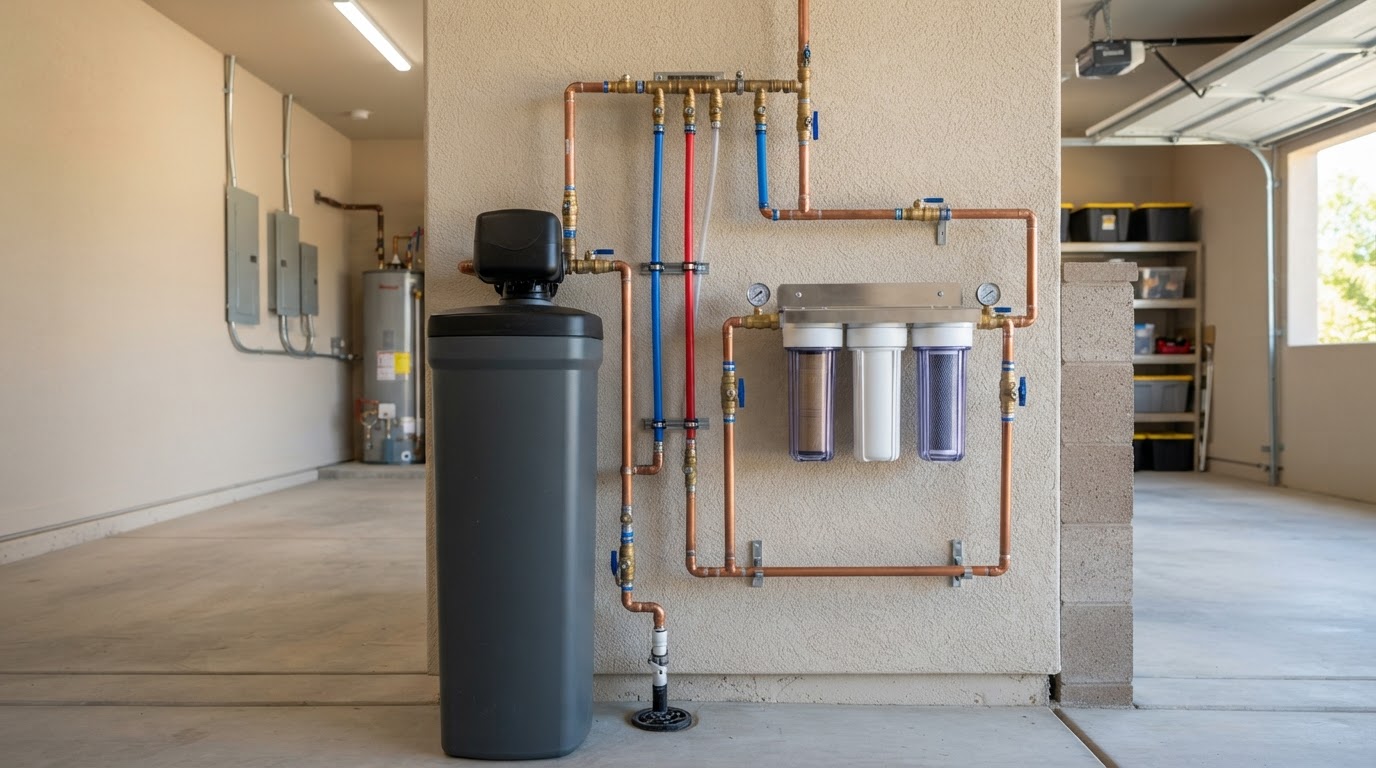
Quick Answer: Water Softener vs Water Filter
A conventional ion-exchange water softener removes dissolved hardness minerals — mainly calcium and magnesium — so they can't form the scale that builds up in water heaters, pipes, and shower doors. It does not reduce chlorine, sediment, or chemical taste and odor.
A water filter reduces specific substances chosen by its technology — sediment cartridges catch particles, activated carbon reduces chlorine taste and odor. But filtration does not soften water: dissolved calcium and magnesium pass right through standard filter media.
In short:
- Filtration does not automatically soften water.
- A conventional softener is not a complete drinking-water purification system.
- Some homes benefit from both, depending on what their water report and a tap test actually show — not every home needs treatment.
Water Softener vs Water Filter: The Key Differences
Softeners and filters both attach to your plumbing, so the two are easy to mix up. They work on different problems, though: a softener pulls dissolved minerals out of the water, while a filter reduces specific substances chosen by its media. The table below compares a conventional salt-based softener, a whole-house filter, and an under-sink reverse osmosis system side by side.
| Feature | Conventional Softener | Whole-House Filtration | Reverse Osmosis (RO) |
|---|---|---|---|
| Primary Purpose | Reduces dissolved calcium and magnesium ions to minimize mineral scale formation. | Reduces specific target substances such as chlorine, sediment, or taste/odor compounds based on media. | Provides point-of-use reduction of total dissolved solids (TDS) and selected chemical contaminants for drinking. |
| What It Treats | Dissolved hardness minerals (calcium Ca²⁺, magnesium Mg²⁺) via cation exchange. | Particulate sediment (sand/rust) or chlorine/VOCs (when certified activated/catalytic carbon is used). | High percentage of dissolved mineral salts, lead, nitrates, fluoride, and micro-contaminants per system certification. |
| What It Does NOT Treat | Does not remove chlorine, disinfection byproducts, bacteria, dissolved organics, or general drinking water TDS. | Does not soften water or remove dissolved calcium/magnesium; does not prevent mineral scale in water heaters. | Not designed for whole-house distribution, high flow demands (showers/appliances), or whole-home pipe protection. |
| Typical Location | Whole-home utility or garage installation on a dedicated plumbing loop upstream of indoor lines. | Whole-house point-of-entry (POE) on main supply line, or point-of-use (POU) cartridge under a single sink. | Point-of-use under the kitchen sink or adjacent utility area, feeding a dedicated tap and refrigerator line. |
| Routine Maintenance | Periodic salt replenishment (typically every 4–8 weeks depending on water use and hardness) and brine check. | Sediment cartridge changes (every 6–12 months) and carbon media replacement as specified by manufacturer. | Pre/post filter cartridge replacement (6–12 months) and semi-permeable membrane replacement (typically 2–3 years). |
| Appropriate Scenarios | Homes experiencing hard water buildup, crusty scale in water heaters, soap scum, and stiff laundry. | Homes where water testing or utility reports indicate sediment, chlorine taste, chemical odor, or specific targets. | Households seeking tested drinking water quality with low TDS directly at the kitchen sink and ice maker. |
Note: Specific reduction claims depend on system design, media grade, independent performance certification, and proper routine maintenance.
Why the Distinction Matters in St. George
In Washington County, deciding between a softener, a filter, or both starts with two pieces of information: what your municipal water actually contains, and how your home's plumbing is set up.
Culinary water in St. George is supplied by the City of St. George Water Services Department and the Washington County Water Conservancy District (WCWCD). It comes from deep groundwater wells in the Virgin River basin and from surface water treated at regional facilities such as the Quail Creek Water Treatment Plant.
Annual Consumer Confidence Reports published by the City of St. George Water Services Department show tap water here typically measures 18 to 22+ grains per gallon (gpg) of hardness (300 to 380+ mg/L CaCO₃). By the U.S. Geological Survey (USGS) and Water Quality Association (WQA) scales, anything above about 10.5 gpg is classified as "very hard."
Hard water is not the same as unsafe water. Calcium and magnesium are normal minerals that pose no health hazard, and St. George's supply meets EPA primary drinking-water standards. The practical issue is mechanical: as hard water heats up or sits in pipes, those minerals settle out as scale inside water heaters, shower valves, and fixtures.
One utility report describes the city's supply as a whole; it does not represent every nearby community, and neighborhood pressure zones and supply blends can shift the numbers. Read your local utility's Consumer Confidence Report (CCR) for the official parameters, then confirm what's coming out of your own tap with an on-site hardness test.
What Does a Water Softener Do?
A conventional ion-exchange water softener runs hard water through a tank of synthetic resin beads coated with sodium or potassium ions. As the water passes over the beads, calcium and magnesium stick to the resin and a small amount of sodium or potassium takes their place in the water. That swap is what "softening" actually means — the hardness minerals leave the water before it reaches your fixtures.
Removing those minerals is what reduces the chain of problems they cause. Calcium and magnesium are what form the chalky scale that builds up inside water heaters and pipes, and they're also what react with soap to leave the sticky film (often called soap scum or curd) on shower glass, faucets, and skin. With the minerals gone, soaps and detergents lather more easily and rinse cleaner, and there's less mineral left to settle out as scale when water heats up or sits in a line.
- Less calcium and magnesium scale inside water heaters and plumbing lines.
- Fewer white spots and less soap scum on shower glass, faucets, and dishes.
- Soaps and detergents lather and rinse without mineral curd.
Once the resin is saturated with hardness minerals, the system runs a regeneration cycle: a concentrated salt brine flushes through the tank, pushing the captured minerals down a dedicated drain and recharging the beads. Sizing the unit depends on your tested grain hardness, how many people live in the home, and your peak flow rate — a system that's too small will regenerate constantly, while an oversized one wastes salt and water.
Softening only treats mineral hardness. It does not remove chlorine, chemical odors, or disinfectants, and it is not a drinking-water purifier.
What Does a Water Filter Do?
"Water filter" isn't one technology — it's a category. Different filters target different things, and a filter's performance depends on its media, how long the water contacts it, the flow rate, and how often the cartridge or media is replaced. The common types you'll see in residential use:
Sediment Filtration
Spun polypropylene or pleated cartridges physically catch sand, silt, pipe scale, and rust particles before they reach faucets and appliances.
Activated Carbon Media
Porous carbon adsorbs chlorine residuals, volatile organic compounds (VOCs), and the tastes and odors that come with them.
Catalytic Carbon Media
A modified carbon formulated to break down chloramines and hydrogen sulfide when the specific unit is certified for those targets.
Two important limits: none of these softens water, and no single carbon filter removes everything. A standard activated-carbon cartridge is not rated for lead, bacteria, or dissolved minerals. To know what a particular filter actually reduces, check its independent certification — NSF/ANSI Standards 42 (taste, odor, chlorine) and 53 (health-related contaminants) are the common benchmarks — and match the certified claim to the substance you're concerned about.
Where Does Reverse Osmosis Fit?
Under-sink reverse osmosis (RO) is a point-of-use drinking-water system — it treats the water at one tap, usually the kitchen sink, rather than the whole house.
It uses household water pressure to push pre-filtered water through a semi-permeable membrane with pores around 0.0001 microns. That membrane rejects a high percentage of total dissolved solids (TDS), dissolved mineral salts, fluoride, nitrates, and certain heavy metals, sending the purified water to a dedicated faucet and refrigerator ice maker while the rejected concentrate runs to the drain. The exact reduction depends on the specific membrane and pre/post filters, so check the unit's NSF/ANSI 58 certification for the substances that matter to you rather than assuming any RO "purifies everything."
A softener conditions water for the entire home to protect plumbing and appliances from scale. RO produces high-purity drinking water at a single faucet. They solve different problems, so pairing an ion-exchange softener on the main line with an under-sink RO system is a common setup — the softener also protects the RO membrane from scale, which helps it last longer.
Two things to plan for: RO produces water slowly and stores it in a small holding tank, so it's sized for drinking and cooking rather than filling a bathtub; and it sends some water to the drain with every gallon produced, so water efficiency varies by system. Pre-filters and the membrane need periodic replacement to keep performance where it should be.
Do You Need a Softener, a Filter, or Both?
Match what you're seeing at home to the right place to start looking. This table pairs common observations with the underlying cause and the equipment worth investigating.
| What You Observe at Home | Underlying Factor | Recommended Investigation |
|---|---|---|
| Mineral scale on faucets, cloudy shower glass, or tankless heater scale warnings | Measured hardness from dissolved calcium and magnesium | Water Softener Installation — Investigate an ion-exchange water softener sized to your household's tested hardness and flow demand. |
| Visible sand, silt, or rust flakes collecting in aerator screens | Physical particulate or suspended solids in the supply line | Investigate a whole-house sediment filter rated for appropriate micron size and flow rate. |
| Noticeable chlorine or chemical disinfectant taste and swimming-pool odor | Municipal disinfectant residuals (chlorine or chloramine) | Whole-House Filtration — Investigate whole-house activated or catalytic carbon filtration verified for disinfectant reduction. |
| Desire for high-purity drinking water, low TDS, or concern with specific dissolved contaminants | Dissolved solids and point-of-use consumption preferences | Reverse Osmosis Systems — Investigate an under-sink reverse osmosis system certified under NSF/ANSI standards for drinking water. |
| Both hard mineral scale on plumbing and chemical taste/odor in tap water | Dual water conditions: dissolved minerals plus municipal treatment additives | Assess a combination approach: whole-house carbon filtration at the entry followed by softening on the loop. |
| Uncertain what is present in your household water supply | Water characteristics vary by neighborhood pressure zone and supply blend | Begin by reviewing your local utility consumer confidence report and obtaining an on-site hardness measurement. |
Important: Appearance, taste, or odor alone cannot establish water safety or complete chemical composition. Always consult official utility reports or certified lab testing.
Explore Options for Your St. George Home
Compare water softener installation details, whole-house filter setups, or reverse osmosis quotes.
What About Salt-Free Water Conditioners?
"Salt-free water conditioner" usually refers to systems that use physical conditioning technologies such as Template Assisted Crystallization (TAC) or Nucleation Assisted Crystallization (NAC).
The key distinction: these units do not remove calcium or magnesium from the water the way an ion-exchange softener does. Instead, they convert dissolved minerals into tiny crystals that are meant to pass through plumbing without sticking to pipe walls and heating tanks.
Because the minerals stay in the water, you'll still see spots on shower glass, faucets, and dishes wherever water evaporates and leaves mineral residue behind. If you're comparing a salt-free conditioner to a true softener, confirm what the specific unit is rated to do against your home's measured grain hardness — the two technologies aren't interchangeable.
Installation, Cost & Maintenance Considerations
Total cost of ownership spans the equipment, the installation labor, and the ongoing maintenance. The factors that move that number most:
Equipment Type & Rated Capacity
System size (grain capacity for softeners, flow rating and media volume for filters) must match household peak demand and water chemistry.
Plumbing Infrastructure & Softener Loop
Homes pre-plumbed with an existing loop and drain line require less labor than homes needing new pipe routing, wall penetrations, or bypass loops.
Drain Line & Dedicated Electrical Supply
Conventional softeners and RO systems require compliant drain tie-ins; electronic control valves require an accessible 120V outlet.
Physical Space & Location Layout
Utility closets or tight garage spaces may require compact cabinet configurations rather than two-tank systems.
Ongoing Consumables & Media Replacement
Ownership expenses include salt pellets for softeners, replacement sediment/carbon cartridges, and periodic RO membrane replacements.
Written Warranty & Service Terms
A complete written estimate should clearly specify valve warranty, tank warranty, labor coverage, and post-installation support.
Reliable price ranges need to be tied to your specific plumbing, home age, and equipment capacity, so we don't publish flat numbers here. A written proposal after an on-site inspection is the dependable way to compare real costs.
Questions to Ask Before Choosing a System
Before you pick equipment or sign off on an estimate, work through these questions:
- 1What specific water condition or symptom am I trying to address in my home?
- 2What do my local municipal water-quality report and home hardness test indicate?
- 3Are the system's performance and contaminant-reduction claims independently certified (e.g., NSF/ANSI or WQA standards)?
- 4Is the equipment properly sized for my household's peak flow rate and occupant count?
- 5Does the written quote detail all materials, valves, drain connections, and installation labor?
- 6What recurring maintenance, salt replenishment, or filter replacements will be required annually?
- 7Who fulfills the warranty and provides ongoing technical service for the installed equipment?
Frequently Asked Questions
Does a whole-house water filter soften water?
No. A whole-house filter addresses targeted substances—such as chlorine, sediment, or chemical odor—based on its filter media. Dissolved calcium and magnesium minerals remain in the water, meaning filtration will not prevent hard-water scale on fixtures or inside water heaters.
Can I have both a water softener and a water filter installed?
Yes. Many homes with multiple goals combine both. A common configuration places a whole-house carbon filter at the point of entry to reduce chlorine and sediment, followed by a water softener on the dedicated loop to remove hardness minerals. Point-of-use reverse osmosis can then be added for drinking water.
Will a water softener improve drinking-water taste?
A water softener changes the mouthfeel of water by removing calcium and magnesium, but it is not a complete purification system. It does not remove chlorine taste or chemical odors. For improved drinking-water quality, homeowners typically pair a softener with an activated carbon filter or reverse osmosis system.
Is reverse osmosis the same as a water softener?
No. A water softener treats the whole house (or indoor hot/cold loop) by exchanging calcium and magnesium ions. Reverse osmosis is typically a point-of-use drinking-water system that forces water through a dense membrane to reduce total dissolved solids, fluoride, nitrates, and other compounds at a dedicated sink tap.
Does every St. George home need the same system?
No. Water characteristics and plumbing configurations vary across Washington County. Sizing and system selection depend on your tested hardness, whether your home has a pre-plumbed loop, household water usage, and your specific priorities.
Can a water softener be installed without an existing loop?
Yes. When a home lacks a dedicated softener loop, an installer must locate the incoming water line, install supply and return piping with a bypass valve, and establish compliant drain and electrical access.
What is the difference between a softener and a salt-free conditioner?
An ion-exchange water softener physically removes calcium and magnesium ions from the water using salt regeneration. Systems marketed as salt-free conditioners do not remove these minerals; rather, they alter crystallization to reduce scale adherence inside pipes, but mineral residue will still appear as water evaporates on surfaces.
How do I determine which treatment my home needs?
Start by reviewing your municipal utility water-quality report and having your home's water tested for hardness and specific concerns. A qualified site evaluation can confirm your plumbing setup and provide a site-specific written recommendation.
Authoritative Sources & References
- City of St. George Water Services: Annual Consumer Confidence and Water Quality Reports.
- Washington County Water Conservancy District (WCWCD): Regional water supply monitoring and Quail Creek Water Treatment Plant documentation.
- Water Quality Association (WQA): Water Hardness Classifications & Cation Exchange Standards.
- NSF International: NSF/ANSI Standards 42, 53, and 58 for Drinking Water Treatment Units.
- U.S. Geological Survey (USGS): Water Hardness Definitions & Regional Groundwater Studies.
Explore Related Water Services
Ready to explore specific equipment options or compare written proposals? Check our dedicated service guides:
Request Guidance for Your St. George Home
Whether you need to confirm your home's water hardness, inspect an existing plumbing loop, or compare quotes for softening, filtration, or reverse osmosis, submit an inquiry below.
Request a Custom Water Treatment Quote
Inquiries are routed to our local water-treatment partner for site-specific evaluations and transparent written estimates.