
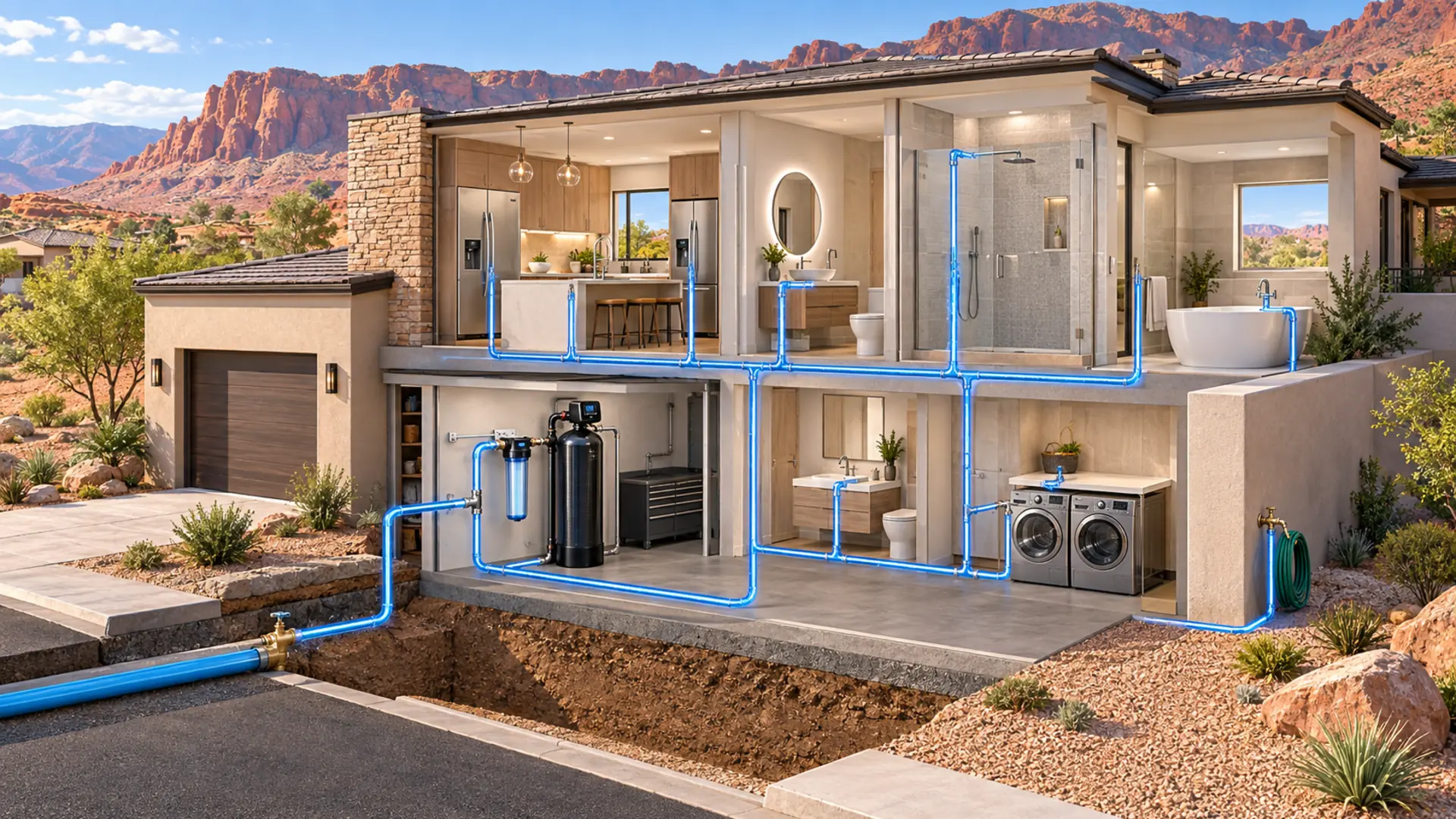
Whole house water filtration in St. George, UT
Whole house water filtration in St. George, UT treats water at the home's entry point, with results determined by the filter technology and the substances it is designed to reduce. A point-of-entry system sends filtered water to every connected fixture downstream—but what it actually reduces depends on the specific media, system design, and verified performance, not a generic "filter" label.
- Reduces chlorine taste and odor throughout the home
- Does not soften water—hardness still requires ion exchange
- Performance is media-specific and verified per system
Request a Filtration Quote
Inquiries routed to our local water-treatment partner for site-specific evaluations.
What whole-house filtration does—and does not—do
A whole-house (point-of-entry) filter treats water where it enters your home, so every plumbing branch connected downstream receives filtered water. Different filters address different concerns: carbon targets chlorine, taste, and odor; sediment filters trap particulates; specialty media address specific substances. Standard carbon and sediment filtration do not remove dissolved hardness minerals the way a conventional ion-exchange softener does, and a whole-house filter is different from a point-of-use reverse osmosis drinking-water system. Treatment should match your water information and your goals—not a one-size-fits-all assumption.
Treats every connected tap
Point-of-entry filtration sends filtered water to all downstream fixtures, not just the kitchen sink.
Not a softener
Carbon and sediment media do not remove hardness minerals. Scale still requires ion-exchange softening.
Performance is media-specific
What a system reduces depends on the media, design, flow, and certified claims—not a generic filter label.
Match it to your goals
Start with your utility report and your specific concern. Not every home needs the same filtration.
What problem are you trying to address?
The right place to start is your actual concern—not a product. Are you noticing sediment, a chlorine taste or odor, or something else? Begin with your utility's current water-quality report, which describes what your municipal supply contains for a defined service area and reporting year. Where useful, supplement it with home testing. Then look at the verified performance of any proposed equipment for the specific issue you identified.
If your only concern is hard-water scale on fixtures and appliances, a water softener is the more direct solution. If your concern is drinking-water taste or dissolved solids at the kitchen tap, compare reverse osmosis systems instead.
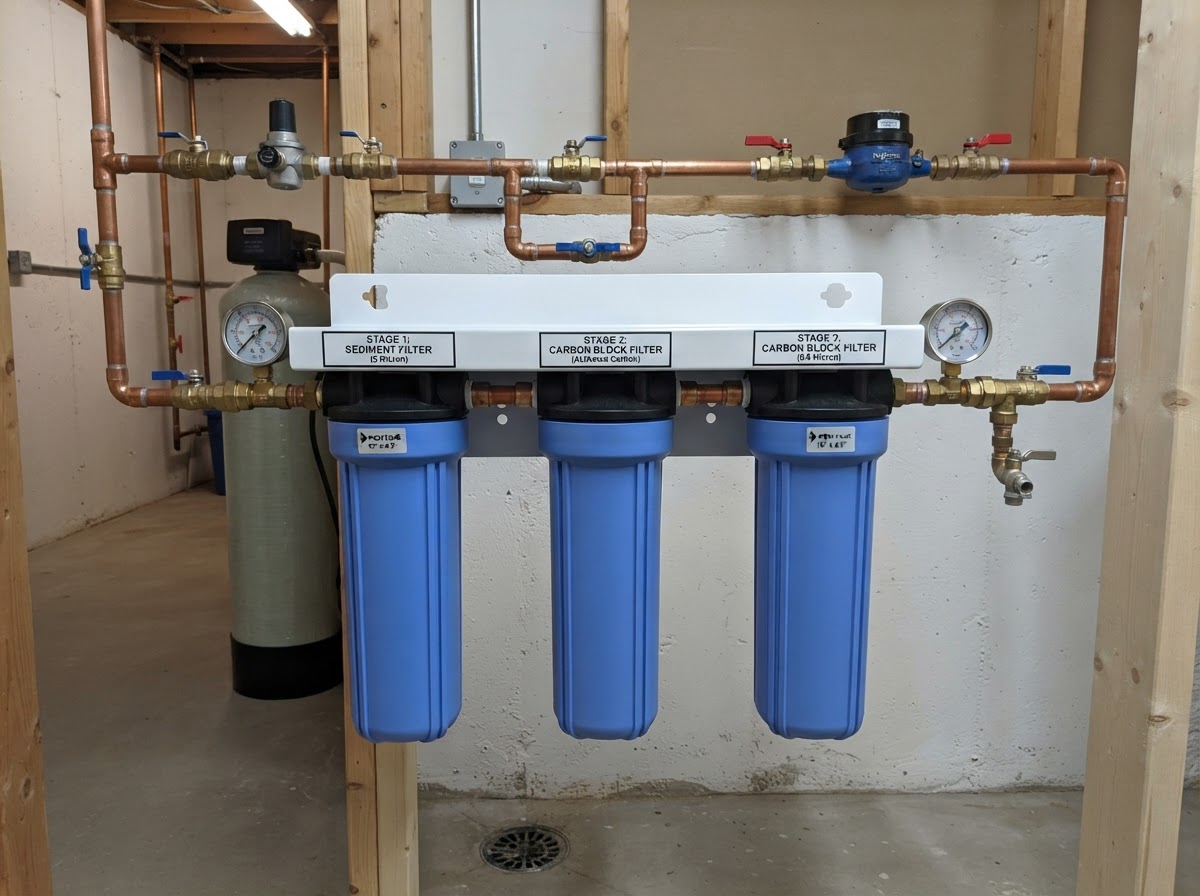
Compare common filtration approaches
These are general technologies. Performance depends on the specific media, system design, flow, capacity, and certified claims. Do not assume every carbon filter reduces chloramine, lead, microbes, dissolved minerals, or all chemicals. Whether a particular option is offered should be confirmed with the provider.
| Approach | Purpose | Limitations | Maintenance |
|---|---|---|---|
| Sediment filtration | Traps particulates (sand, silt, rust) before downstream equipment | Does not reduce chlorine, chemicals, or dissolved minerals | Cartridge replacement based on loading and usage |
| Activated carbon | Reduces chlorine, taste, odor, and certain chemicals via adsorption | Does not soften water; chloramine reduction depends on media & certification | Cartridge or media replacement on a usage-based schedule |
| Catalytic carbon | Designed to address chloramine and certain chemicals where certified | Performance is media-specific; verify the tested claim for your target substance | Media servicing or replacement per manufacturer guidance |
| Specialty treatment | Selected for a verified need (e.g. a specific substance identified in testing) | Must match the verified contaminant and certified reduction claim | Varies by media and system; follow manufacturer schedule |
Whole-house filtration versus softening versus reverse osmosis
These three technologies do different jobs. Filtration targets particular substances—commonly chlorine, taste, odor, and sediment—at the point of entry. Conventional softening reduces hardness minerals (calcium and magnesium) through ion exchange to limit scale. Point-of-use reverse osmosis reduces a broad range of dissolved solids for drinking water at the kitchen tap, with capabilities defined by the specific system's certified performance.
Combining systems may be considered when a household has more than one goal—for example, a carbon filter ahead of a softener, or a softener plus an under-sink RO system. But the right combination depends on your water and goals; we do not recommend the same setup for every home. For the full comparison, read our Water Softener vs. Water Filter guide and the water softener installation and reverse osmosis service pages.
Flow rate and water pressure
A whole-house system should be sized so household water pressure is maintained during simultaneous use. The relevant factors are peak simultaneous demand (how many fixtures run at once), the system's rated service flow, and the pressure loss through the filter. As a filter loads with sediment or reaches capacity, resistance increases and pressure can drop. That is why plumbing size alone does not establish treatment capacity—a large pipe feeding an undersized filter still restricts flow.
- Peak demand—running a shower, washing machine, and dishwasher at once sets the flow the system must support.
- Rated service flow—the manufacturer's rated flow tells you the rate at which treatment performance is evaluated.
- Pressure loss—any filter adds resistance; a loaded or undersized filter drops pressure more.
- Maintenance—replacing cartridges or servicing media on schedule keeps resistance low.
Treatment performance must be evaluated at the intended flow rate. Confirm the rated service flow and pressure considerations with the provider for your specific fixtures and demand.
What installation involves
A proper estimate accounts for your plumbing layout, not just the equipment. Here is what is typically evaluated.
Water entry point
Locating the appropriate main water entry point for point-of-entry treatment.
Treated branches
Confirming which fixtures and branches will receive treated water downstream of the system.
Space & access
Room for the equipment plus clear access for servicing and future filter changes.
Shutoffs & bypass
Shutoff valves and a bypass arrangement so you can isolate the system for service.
Drain for backwash
A drain connection for backwashing media-tank systems that clean the media bed.
Power where required
A nearby outlet for control valves that need electricity, where applicable.
Placement relative to other equipment
Positioning relative to a softener or other treatment per equipment specifications.
Startup & instructions
Startup, leak checks, and homeowner maintenance guidance after installation.
Do not assume irrigation is automatically filtered or excluded. The actual plumbing arrangement must be checked to confirm whether the irrigation branch passes through the system. We do not invent universal plumbing or electrical requirements—confirm what your chosen system needs with the provider.
Cartridge systems
Drop-in cartridge filters are common for sediment and carbon treatment. They are compact, simple to plumb, and typically need no drain or electricity. Replacement is straightforward, though cartridges are swapped more often than media beds.
- Compact; usually no drain or power needed
- Simple cartridge replacement
- More frequent replacement intervals
Backwashing media tanks
Media-tank systems hold a larger bed of carbon or specialty media and periodically backwash to clean it. They offer higher capacity and longer media life, but need a drain for backwash water and may require power for the control valve.
- Higher capacity; longer media life
- Requires drain for backwash; may need power
- Less frequent media servicing
Neither configuration is universally better. The right choice depends on your water, space, flow needs, and maintenance preference. Confirm what is appropriate for your home with the provider.
Installation and ownership cost factors
We do not publish a single dollar range because verified local installed pricing is not available to publish here. Instead, these are the variables that shape both the installation quote and long-term ownership cost.
| Cost factor | How it affects the quote |
|---|---|
| Equipment type & goals | Cartridge vs. media tank, media type, and treatment targets change equipment cost. |
| Required flow & capacity | Larger systems sized for higher peak demand cost more. |
| Plumbing modifications & access | Tight installations or rerouting to the entry point add labor. |
| Drain or electrical work | Backwashing systems may need a drain; some valves need an outlet. |
| Cartridges, media & service | Ongoing ownership cost depends on replacement intervals and parts. |
| Combining equipment | Pairing with a softener or RO may share some labor; ask about a combined quote. |
Distinguish equipment-only prices from installed prices, and ask the provider to separate equipment, labor, and any optional work in the written estimate. We do not present national estimates or equipment-only prices as St. George installed prices.
Want a home-specific filtration estimate?
Tell us what you are noticing—chlorine taste, sediment, or a specific concern—and our local water-treatment partner will recommend the right setup for your home.
Maintenance and signs service may be needed
Follow the manufacturer-specified replacement and service schedule for your system. Capacity, water conditions, and usage all affect how often a cartridge or media bed needs attention—there is no single universal interval for every home.
- Pressure changes—a noticeable drop in flow can mean a loaded filter needs replacement.
- Leaks—drips at fittings or the housing warrant a service check.
- Returning taste or odor—if chlorine taste or odor comes back, the carbon media may be exhausted.
How to compare filtration quotes
- What problem is being addressed? The quote should match your identified concern.
- What exact model and media are proposed? Compare the same equipment across quotes.
- Which specific reduction claims are verified? Match the certified claim to your target substance.
- At what rated flow and capacity? Ensure the system supports your peak demand.
- What installation work is included? Labor, plumbing, drain, and any electrical work.
- Which fixtures will receive treated water? Confirm the plumbing branches covered.
- What consumables and service will be needed? Cartridge or media replacement intervals and cost.
- Who provides the warranty, and what does it cover? Confirm the issuer, coverage, and exclusions.
Whole-House Filtration FAQs
Does a whole-house water filter soften water?
No. Standard whole-house filters reduce chlorine, taste, odor, and sediment, but they do not remove dissolved calcium and magnesium—the minerals that cause hard-water scale. Stopping scale requires ion-exchange softening. Many homes install a filter and a softener together, with the filter often placed ahead of the softener to help protect its resin from chlorine.
Do I need both a filter and a softener?
It depends on your goals. If your concern is chlorine taste or odor throughout the home, whole-house filtration may help. If your concern is scale on fixtures, water heaters, and glass, a softener is the more direct solution. If you have both concerns, the two systems are frequently combined. Start with your utility water report and your specific goals rather than assuming every home needs both.
Can whole-house filtration reduce chlorine or chloramine?
Activated carbon is commonly used to reduce chlorine taste and odor. Whether a particular system reduces chloramine depends on the specific media—often catalytic carbon—and its certified performance. A brand logo or a generic 'carbon filter' label does not prove chloramine reduction. Confirm the model's tested claim for the exact substance you care about.
Will a whole-house filter affect water pressure?
Any filter adds some resistance to flow. A properly sized system is selected to maintain adequate pressure during peak household use, but pressure can drop if the filter loads up or is undersized for your demand. The right size depends on your fixtures, peak flow, and the selected equipment—not pipe size alone. Confirm the rated service flow with the provider.
Does every whole-house system need a drain or electricity?
No. Cartridge-style filters typically need no drain or power. Backwashing media-tank systems use water to clean the media bed and may require a drain connection; some control valves need a nearby outlet. The requirements depend on the specific equipment selected. The installer confirms what your chosen system needs.
How often do filters or media need replacement?
Replacement intervals depend on your water, the specific media or cartridge, household usage, and the system's capacity. Sediment cartridges are usually replaced more often than carbon media. Follow the manufacturer's recommendation and the provider's guidance based on your actual conditions rather than a single fixed interval for every home.
Does whole-house filtration treat the outdoor irrigation supply?
Not automatically. Whether irrigation water passes through the filter depends on how your plumbing is arranged and where the system is installed relative to the irrigation branch. The installer checks your actual plumbing layout to confirm which fixtures and branches receive treated water. If irrigation treatment matters to you, mention it in your inquiry.
Is a whole-house filter the same as an under-sink RO system?
No. A whole-house filter treats water at the main entry so every connected tap gets filtered water for chlorine, taste, odor, and sediment. An under-sink reverse osmosis system is a point-of-use drinking-water treatment that reduces a broad range of dissolved solids at a dedicated kitchen faucet. They serve different purposes and are often used together.
Request a Whole-House Filtration Estimate
Inquiries routed to our local water-treatment partner for site-specific evaluations.