
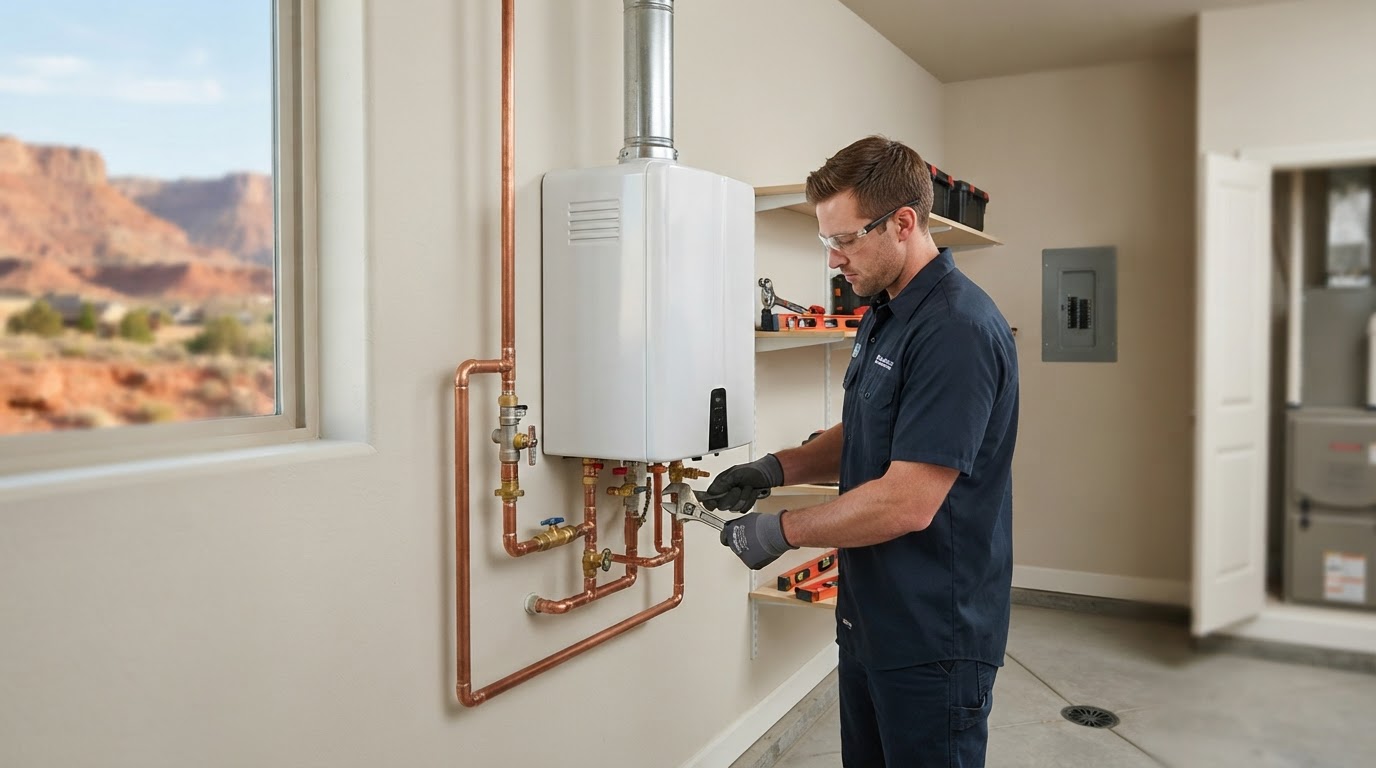
Tankless water heaters in St. George, UT
Tankless water heaters in St. George, UT heat water on demand without a storage tank, saving space and eliminating standby heat loss. The trade-offs are a limited delivery rate at a given temperature rise, possible gas or electrical upgrades, and the need to manage hard-water scale on the heat exchanger.
- Continuous hot water sized to peak flow
- Compact, wall-mounted installation
- Descaling and softening based on your actual water
Request a Tankless Estimate
Inquiries routed to our local water-treatment partner for site-specific evaluation.
Is a tankless water heater right for your home?
A tankless heater activates only when a hot tap opens, heating water as it flows through a heat exchanger. It provides continuous hot water within its flow limit—no stored volume and no standby heat loss. Whether it fits your home depends on your peak simultaneous demand, the required temperature rise, your fuel and utility capacity, and how you want to manage hard-water scale. It is not automatically the best choice for every St. George home.
Flow, not volume
Sizing is GPM at a required temperature rise, not tank gallons.
Not instant at the tap
Water still travels through pipes; wait time depends on distance.
Utility upgrades possible
Gas line, venting, or electrical service may need upgrading.
Scale management
Descaling follows the manufacturer schedule for your water.
How on-demand heating works
A tankless heater activates only when a hot tap opens, heating water as it flows through a heat exchanger. Sizing is based on gallons per minute (GPM) at the required temperature rise—how much the unit must warm incoming groundwater for your typical simultaneous use.
A unit's maximum advertised flow is usually rated at a specific temperature rise. Where incoming water is colder, the same unit delivers fewer gallons per minute at your target output temperature—so the headline number may not match your actual operating conditions. Continuous hot water is not the same as unlimited flow.
Key considerations
- Peak simultaneous demand drives sizing, not household size alone
- Incoming water temperature affects real-world GPM
- Pipe distance, not the heater, sets faucet wait time
For the full side-by-side comparison, see our tank vs. tankless guide.
Considering a tankless water heater?
Share your household demand and our local water-treatment partner will help you compare tankless against a traditional tank.
Gas versus electric, venting, and utility upgrades
Tankless units have equipment-specific power and venting requirements. Gas models need adequate gas supply and dedicated venting; electric models can require a upgraded electrical service because of the high instantaneous load. Condensate drainage may apply to some high-efficiency gas units. These requirements are confirmed for the exact model being quoted—not assumed.
Gas tankless
- May need a larger gas line for the higher instantaneous load
- Dedicated venting path per the manufacturer's spec
- Condensate drainage where applicable
Electric tankless
- May require upgraded electrical service and dedicated circuits
- No combustion venting, but capacity depends on electrical supply
- Service clearances and plumbing access still apply
Hard-water assessment and maintenance
In hard-water areas, mineral scale can coat the heat exchanger and reduce efficiency, so periodic descaling is part of ownership. Follow the manufacturer's descaling schedule based on your actual water conditions—there is no universal annual interval that fits every home. A water softener can slow scale buildup but is not mandatory for every installation and does not guarantee equipment longevity.
Maintenance guidance here is for planning only. Gas and electrical work should be left to a qualified professional.
Installation and ownership cost factors
- Equipment capacity (GPM rating) and controls
- Gas line, venting, or electrical service upgrades
- Condensate drainage where applicable
- Plumbing layout, placement, and service access
- Descaling and replacement parts over the unit's life
We do not publish invented prices. A site-specific estimate is required for an accurate total, and any payback comparison must disclose equipment costs, usage, utility rates, and maintenance assumptions.
When tankless may or may not suit your home
May suit
- Limited equipment space for a floor-standing tank
- Long, sustained hot-water use within the unit's flow rating
- A remodel where utility upgrades are already in scope
May not suit
- Very high simultaneous demand exceeding one unit's flow
- A tight budget where upgrade costs outweigh the benefits
- Homes where utility upgrades aren't feasible
Tankless Water Heater FAQs
Does tankless mean unlimited hot water?
No. A tankless unit heats water continuously, but only up to its flow limit at the required temperature rise. If total demand exceeds that rating, the unit can't keep up—so continuous hot water is not the same as unlimited flow.
Does tankless give instant hot water at the faucet?
Not automatically. The heater warms water the moment a tap opens, but that water still travels through the pipes to the fixture. A tap far from the unit can still have a wait. Recirculation can reduce the wait but adds equipment and energy considerations.
Do tankless water heaters work with St. George's hard water?
They can, but hard-water scale can build on the heat exchanger and reduce performance. Follow the manufacturer's descaling schedule based on your actual water conditions rather than a universal interval. A water softener can slow scale but is not mandatory for every home.
Does a tankless unit require electricity?
Most tankless units require electricity for ignition and controls, so they typically won't heat water during a power outage. Gas and electric models have different power and venting requirements—confirm the equipment-specific needs for the model being quoted.
Can a tankless unit supply a whole house?
Yes, when sized to the home's peak flow rate—the total gallons per minute needed when multiple fixtures run at once. Incoming groundwater temperature also affects how much the unit can raise the temperature at a given flow. A larger unit or multiple units may be needed for high simultaneous demand.
Does switching to tankless require upgrades?
It can. Gas tankless units may need larger gas piping and dedicated venting, and electric units may require upgraded electrical service. Condensate drainage may also apply. These requirements are reviewed and itemized during the estimate.
Sources
- U.S. Department of Energy, "Tankless or Demand-Type Water Heaters" — energy.gov/energysaver/tankless-or-demand-type-water-heaters
- U.S. Department of Energy, "Sizing a New Water Heater" — energy.gov/energysaver/sizing-new-water-heater
- ENERGY STAR water heaters — energystar.gov/products/water_heaters
Flow rates, efficiency ratings, and maintenance intervals should be confirmed against the manufacturer's documentation for the exact model being quoted.