
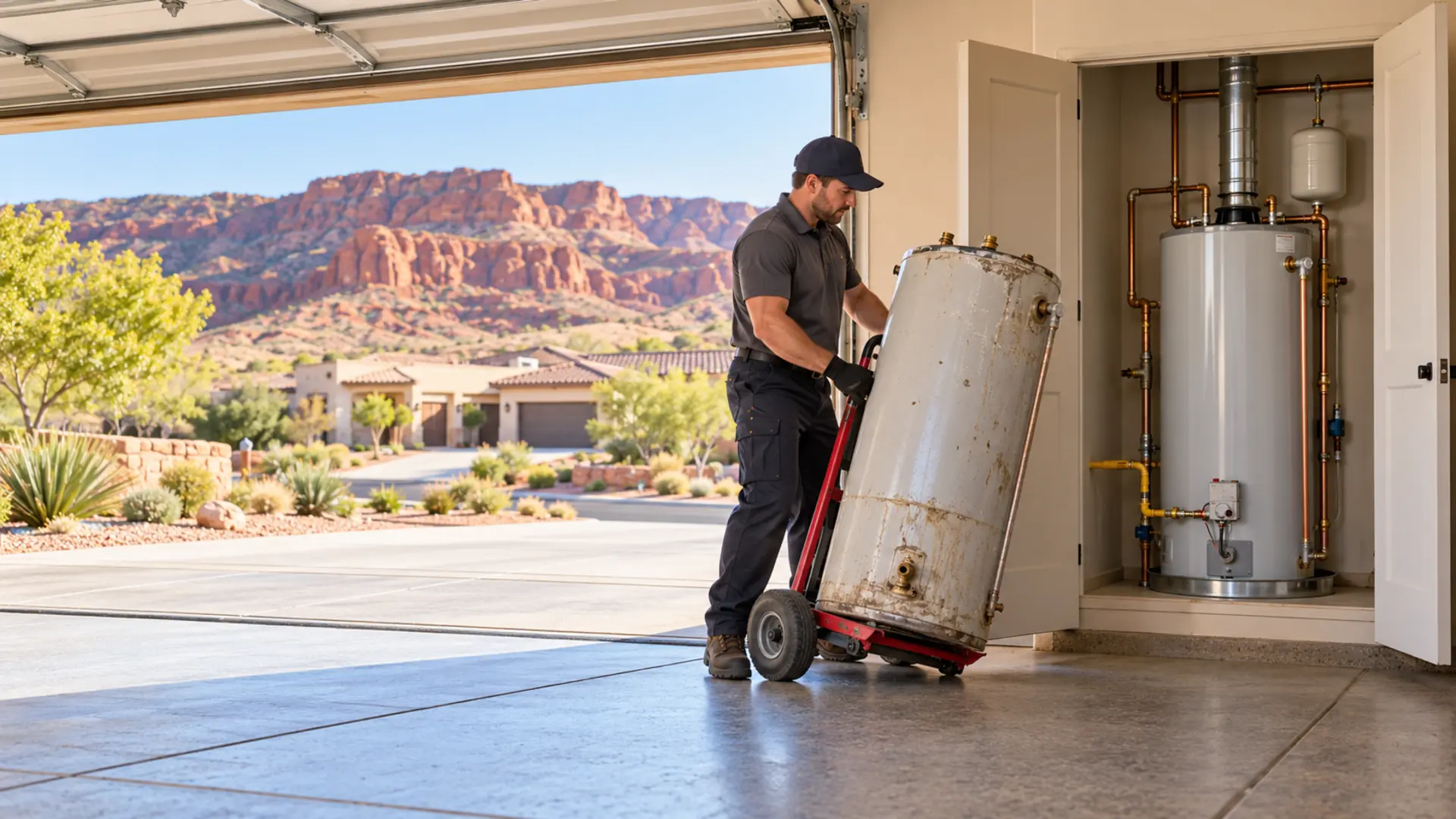
Water heater replacement in St. George, UT
Water heater replacement in St. George, UT is worth comparing when an aging unit leaks, recovers slowly, or has accumulated years of hard-water scale. Deciding between a repair and a replacement depends on the failure type, the unit's condition and history, and your household's changing demand—not on age alone.
- Repair-vs-replace evaluation, no invented threshold
- Like-for-like or technology change, itemized in writing
- Safe removal, disposal, and startup documentation
Request a Replacement Estimate
Get a written upgrade proposal including old-unit removal.
When replacement makes sense
Replacement is usually the right call when a tank body leaks or when repeated repairs add up on a unit past its useful service life. A single repairable component on a newer unit may be worth fixing instead. The decision combines the failure type, the unit's condition and repair history, warranty and parts availability, and whether your household's hot-water demand has changed. Age, noise, or slow recovery alone do not prove replacement is necessary.
Signs you may need a water heater replacement
Leaking tank
A leak from the tank body usually means internal corrosion has breached the steel. Tank-body leaks are rarely repairable and typically call for replacement. A leak from a fitting or valve may be repairable instead.
Slow recovery
Sediment and scale can insulate the bottom of the tank, slowing heat transfer so hot water runs out faster. Slow recovery alone is a reason to assess—not automatically to replace.
Repeated repairs
A history of repeated failures, hard-to-find parts, or a unit well past its service life can make replacement the better value. Weigh this against a single, simple repair on a newer unit.
For a repairable symptom on a unit that is still within its service life, see our water heater repair page. Service-life estimates vary by model, water conditions, and maintenance—refer to manufacturer documentation and warranty terms rather than a single average figure.
Replacing a failing water heater?
Describe the symptoms and unit age, and our local water-treatment partner will provide a written replacement estimate.
What replacement involves
Shut off fuel and water, then drain the old tank safely.
Haul-away of the old unit, itemized in the estimate.
Plumb, vent, and connect the new tank or tankless heater.
Test temperature, pressure relief, and leak-free operation.
Like-for-like replacement
Replacing a tank with a similar tank—same fuel and general location—is usually the simplest path. Connection compatibility is more likely, and upgrade costs are lower. Still, the condition of existing plumbing, venting, and utility capacity should be checked.
Changing fuel or technology
Switching to tankless or a different fuel can require gas line, venting, electrical, or plumbing upgrades. Space, access, and connection compatibility all matter. Any conversion work should be itemized in a written estimate. See our tank vs. tankless comparison for the full trade-offs.
Questions to ask before accepting a replacement quote
- How was the new unit sized to my household demand?
- What exact model and fuel type are proposed?
- What installation changes are included, and what is excluded?
- Is old-unit removal and disposal included?
- What warranty covers the equipment and the labor?
- Who handles permits and inspections where applicable?
- What startup checks and documentation will I receive?
Water Heater Replacement FAQs
How long do water heaters last in St. George?
Service life varies by model, water conditions, and maintenance—there is no single St. George-specific lifespan. Manufacturer documentation and warranty terms are the best reference for a given unit. Age is one factor; leaks and recovery problems are stronger signals to replace.
Should I repair or replace my water heater?
It depends on the failure type, the unit's age, warranty status, parts availability, and the repair cost relative to replacement. A tank-body leak usually means replacement; a single failed part on a newer unit may be worth repairing. There is no fixed percentage threshold that applies to every situation.
Is old-unit removal included?
Removal and disposal of the old unit should be itemized in your written estimate. Confirm whether haul-away is included or an add-on before the work begins.
Can I change fuel type or switch to tankless during a replacement?
Often, yes, but changing fuel or technology can require gas, venting, electrical, or plumbing upgrades. A like-for-like replacement is usually simpler. Any conversion work should be itemized in a written estimate rather than assumed.
Does age alone mean I should replace my water heater?
No. Age is one consideration, but noise or slow recovery alone does not prove replacement is necessary. Combine age with the actual failure, repair history, and your household's changing demand to decide.
What questions should I ask before accepting a replacement quote?
Ask how the new unit was sized, what exact model and fuel are proposed, what installation changes are included and excluded, whether removal is included, what warranty covers equipment and labor, and who handles permits and inspections where applicable.
Sources
- U.S. Department of Energy, "Sizing a New Water Heater" — energy.gov/energysaver/sizing-new-water-heater
- ENERGY STAR water heaters — energystar.gov/products/water_heaters
Service-life and warranty details should be confirmed against the manufacturer's documentation for the exact model being quoted.