
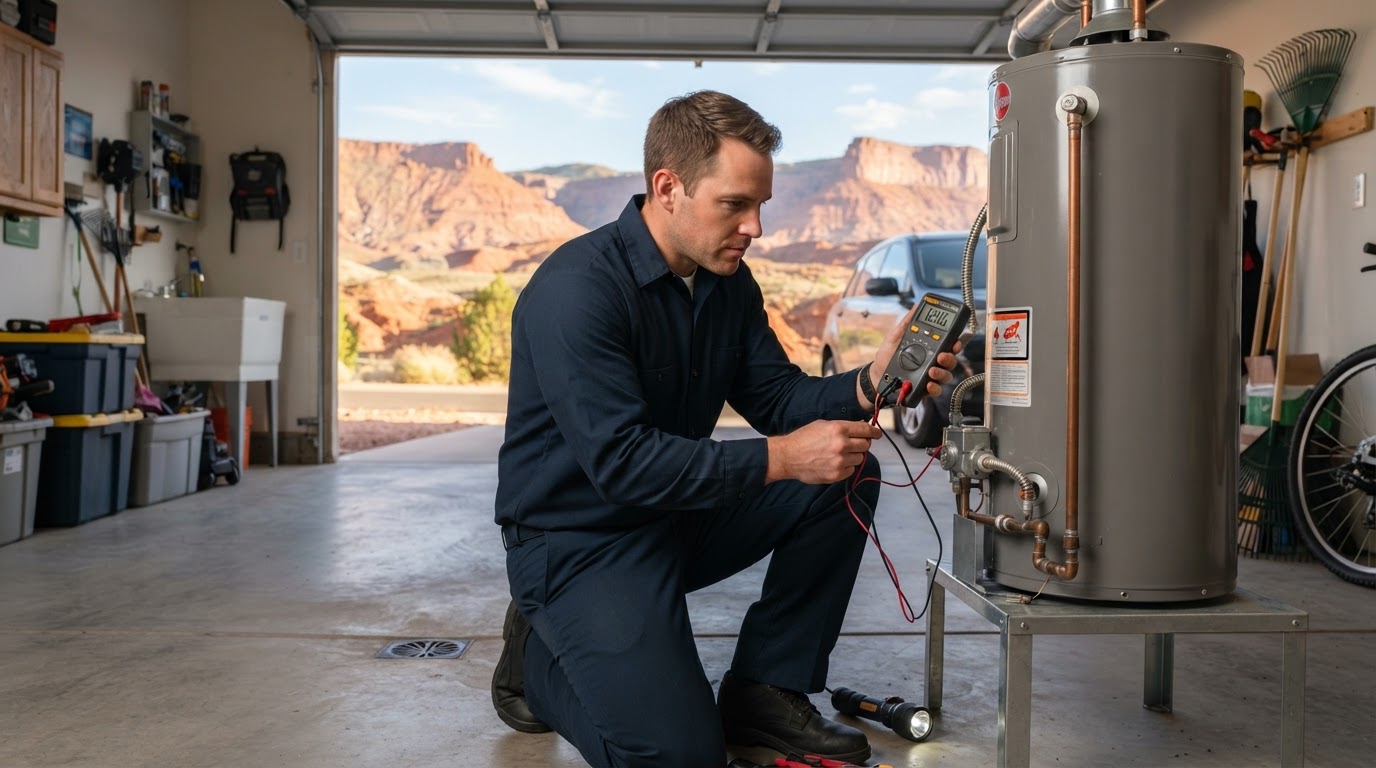
Water heater repair in St. George, UT
Water heater repair in St. George, UT starts with understanding the symptom—not guessing the cause. No hot water, leaks, rumbling, and slow recovery can each have several explanations, and hard-water scale is only one of them. Knowing what to observe before booking helps a technician diagnose the real problem.
- Symptom-based guidance, not remote diagnosis
- Honest repair-vs-replace factors
- Service provided by our local water-treatment partner
Request a Water Heater Assessment
Share your symptoms to schedule diagnostic service.
Safety first: urgent hazards are not a form request
If you smell gas, suspect a gas leak, see flooding that could reach electrical components, or notice any electrical hazard, leave the area and contact the appropriate emergency service or your gas utility immediately. This inquiry form is for scheduling a routine service request during normal business follow-up—it is not an emergency response channel. For any gas, electrical, combustion, or pressure-relief issue, rely on a qualified professional rather than attempting repair yourself.
What to do before booking a repair
Observe the symptom and gather a few facts—unit type and fuel, approximate age, when the problem started, and where any leak appears. Then request a diagnostic assessment. The same symptom can have multiple causes, so a technician confirms the actual failure rather than assuming one. Homeowner guidance here is limited to observing symptoms and following the manufacturer's instructions; gas, electrical, combustion, and pressure-relief work should always be left to a qualified professional.
Common water heater symptoms
Each symptom can have more than one cause. Use this table to know what to observe and report—not to diagnose a specific failed part remotely.
| Symptom | Possible causes requiring diagnosis | Information to give the technician | Appropriate next step |
|---|---|---|---|
| No hot water | Tripped breaker or blown pilot, failed thermocouple or heating element, malfunctioning gas control valve, or sediment insulating the tank. | Unit type and fuel; whether the breaker or pilot is on; whether other gas appliances work. | Observe and report; let a technician diagnose the actual component. |
| Inconsistent temperature or slow recovery | Sediment or scale buildup, a failing element or burner, or a thermostat issue. Multiple causes are possible. | How long recovery takes and when it started; recent changes in household use. | Request a diagnostic assessment. |
| Leaks | A fitting, valve, or drain connection may be repairable; a leak from the tank body usually means internal corrosion. | Where the water appears—around a fitting, the base, or the tank itself. | If leaking near gas or electrical connections, contact a professional; a tank-body leak usually means replacement. |
| Unusual sounds (rumbling, popping) | Sediment trapped at the bottom of the tank can boil and pop. Not every noise means failure. | When the sound happens (during heating cycles) and how long it has occurred. | Flushing may help; heavy buildup may signal replacement. |
| Discolored or odorous water | A degraded anode rod, corrosion inside the tank, or a water-supply issue unrelated to the heater. | Whether it affects only hot water or both hot and cold; how long it has lasted. | Request an assessment; a degraded anode rod can sometimes be replaced. |
| Tankless error codes | Error codes point to specific faults—ignition, flow sensor, flame failure, or scale buildup, depending on the model. | The exact error code shown on the display and the model number. | Report the code; the technician checks it against the manufacturer's documentation. |
Water heater not performing?
Describe the symptom and unit type, and our local water-treatment partner will help you decide between a repair and a replacement.
What to gather before booking
- Unit type and fuel: tank or tankless, gas, electric, or propane.
- Approximate age: check the install tag or serial date code.
- Symptom details: when it started, where any leak appears, and any error codes on a tankless display.
If the unit is past mid-life or the tank is leaking, compare our water heater replacement page.
What a diagnostic visit may assess
- The actual failed component, confirmed by testing
- Sediment or scale buildup and whether flushing or descaling applies
- The condition of the anode rod, valves, and connections
- Whether the unit is a candidate for repair or nearing replacement
What affects your options
- Parts availability: whether the needed part is in stock or orderable for your model.
- Warranty status: whether the unit or part is still under warranty.
- Repair-vs-replace: the unit's age, failure type, and repair cost relative to replacement—no fixed percentage rule applies to every case.
Which equipment types or brands the partner services should be confirmed during your request rather than assumed.
Water Heater Repair FAQs
Why did my water heater stop producing hot water?
There are several possible causes—a tripped breaker, a failed heating element or thermocouple, a malfunctioning gas control valve, or heavy sediment insulating the tank. Because the same symptom can come from different failures, a technician diagnoses the actual cause rather than assuming one. Observing what you see and hear before booking helps that diagnosis.
Is a leaking water heater repairable?
A leak from a fitting or valve may be repairable. A leak from the tank body usually means internal corrosion and generally requires replacement. Note where the water appears before requesting service so the technician knows where to look.
Does hard water cause water heater problems?
It can contribute. Hard water can form sediment and scale that may reduce recovery, cause rumbling, and shorten unit life. But not every problem is caused by hardness—follow the manufacturer's flushing schedule based on your actual water conditions, and let a technician confirm the cause.
What should a repair estimate include?
The diagnosed problem, the specific parts and labor needed, the cost of those parts and labor, any warranty on the repair, and—where the unit is older—a note on whether repair or replacement is the better value. It should not include work that was not explained to you.
How do I decide between repair and replacement?
Consider the unit's age, the type of failure, parts availability, warranty status, and the cost of the repair relative to replacement. There is no fixed percentage threshold that applies to every situation. A leaking tank usually means replacement; a single failed part on a newer unit may be worth repairing.
Does the quote form provide emergency service?
No. This inquiry form is for scheduling a service request during normal business follow-up, not for emergency response. If you smell gas, see flooding, or have an electrical hazard, contact the appropriate emergency service or utility immediately rather than using this form.
Sources
- U.S. Department of Energy, "Sizing a New Water Heater" (recovery and demand context) — energy.gov/energysaver/sizing-new-water-heater
- ENERGY STAR water heaters — energystar.gov/products/water_heaters
Diagnosis and parts details should be confirmed against the manufacturer's documentation for your specific model. This page does not provide gas, electrical, or internal repair procedures.