
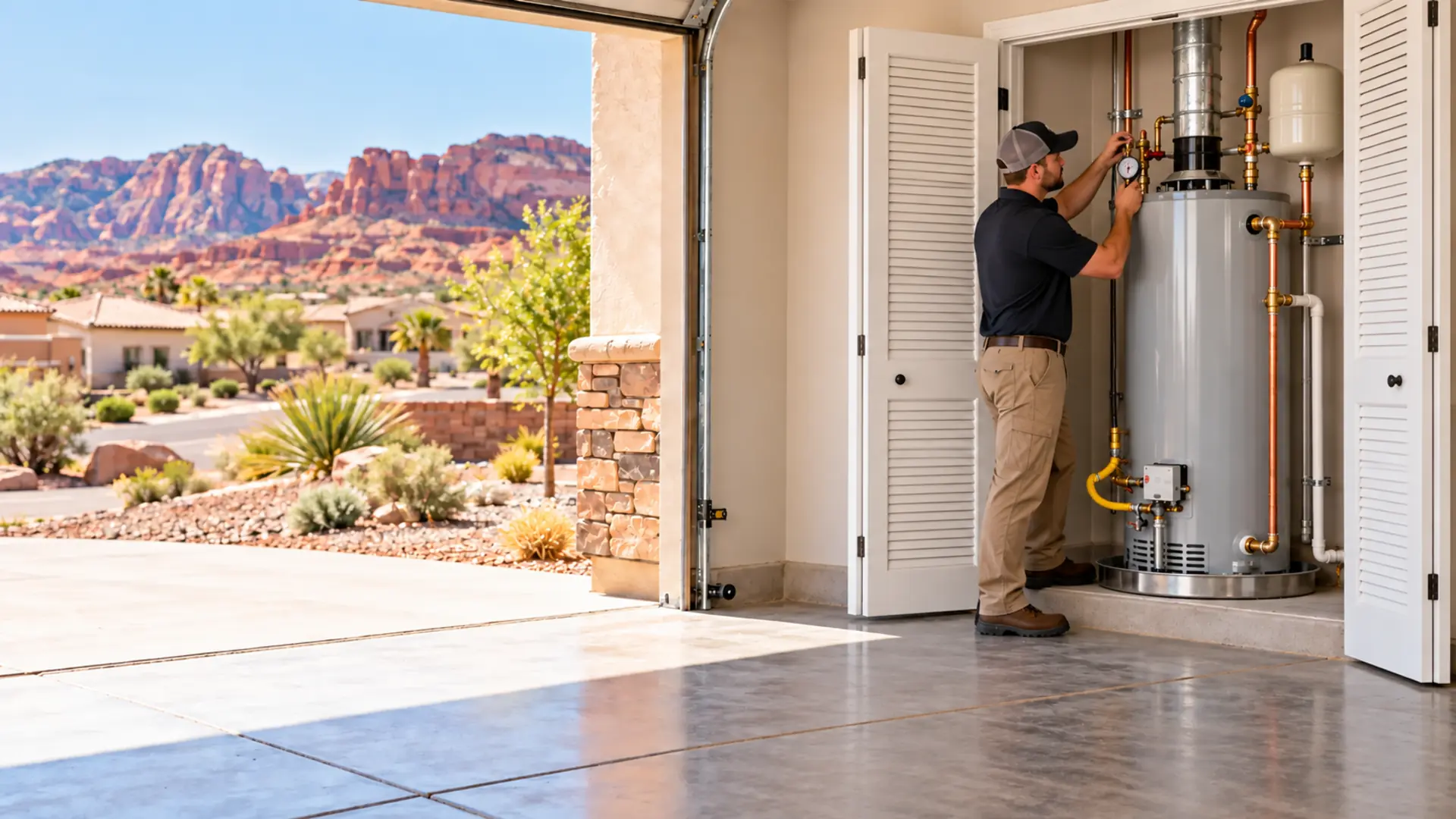
Water heater installation in St. George, UT
Water heater installation in St. George, UT starts with matching the unit to your household's peak hot-water demand, fuel type, and the space where it will live. A good installation plan also accounts for hard water, which can affect sediment and scale buildup over time.
- Sized to peak demand, not just household size
- Fuel, venting, and utility capacity reviewed
- Hard-water planning and maintenance guidance
Request an Installation Estimate
Inquiries routed to our local water-treatment partner for site-specific proposals.
What a water heater installation involves
A water heater installation means choosing equipment sized to how your household actually uses hot water, confirming the fuel and utility connections can support it, placing it with the right clearances and venting, and starting it up correctly. Before recommending equipment, an installer should understand your usage, your existing setup, and your water conditions—not just the number of bedrooms or occupants.
Size to demand
Peak simultaneous use drives sizing, not household size alone.
Check the space
Clearances, venting, drainage, and utility access must fit the unit.
Get it in writing
A clear proposal lists equipment, labor, upgrades, and total price.
What the installer needs to know before recommending equipment
Sizing a water heater is not a guess based on the number of people in the home. The installer should look at how much hot water you use at once, what fuel and utility connections are already in place, and where the unit will sit.
- Fuel type: natural gas, propane, or electric—and whether the existing supply can support the chosen unit.
- Household usage and peak demand: how many fixtures or appliances run at the same time.
- Existing installation: current unit type, plumbing layout, and venting path.
- Water conditions: your actual hardness information, where available, to plan for scale and sediment.
How sizing differs by type
- Storage tank: tank size plus the first-hour rating and recovery rate.
- Tankless: gallons per minute (GPM) at the required temperature rise, which depends on incoming water temperature.
- Household size alone is not enough—two people who run three fixtures at once can need more capacity than four who rarely overlap.
For the full side-by-side comparison, see our tank vs. tankless guide.
Space, clearances, and utility requirements
The installation location has to fit the equipment and the code-required clearances around it. A storage tank needs floor space and service access; a wall-mounted tankless unit needs wall space and clearance for venting and maintenance.
What gets reviewed
- Service clearances and access for future maintenance
- Venting path for gas units and condensate drainage where applicable
- Drain pan and temperature/pressure relief valve for tank units
- Utility capacity—gas line size or electrical service rating
Potential upgrades
Gas tankless units may need a larger gas line and dedicated venting. Electric tankless units can require a upgraded electrical service because of the high instantaneous load. These upgrades are part of the installation scope and should be itemized in a written estimate rather than assumed.
Permits and inspections are typically required where local code mandates them. Confirm with the relevant local building authority and ask whether they are included in the proposal. Requirements can vary by jurisdiction.
Planning a new water heater?
Share your household size and current setup, and our local water-treatment partner will provide a written estimate.
What a written installation proposal should include
In the proposal
- Exact equipment model and capacity
- The basis for sizing (demand calculation)
- All labor, plumbing, and connection work
- Any fuel, venting, or electrical upgrades
- Permits and inspections where applicable
- Old-unit removal and disposal, if applicable
- Startup, testing, and homeowner handoff
- Warranty terms and total price with any potential extra charges
Cost factors
- Unit type and capacity (tank gallon size or tankless GPM rating)
- Fuel type and any gas or electrical upgrades
- Venting, drain pan, and code-required safety components
- Removal and disposal of an existing unit, if applicable
We do not publish invented prices. A site-specific estimate is required for an accurate total.
Startup checks and homeowner handoff
After the unit is connected, the installer should start it up and verify safe operation. That typically includes checking temperature settings, the temperature/pressure relief valve, leak-free connections, and proper venting for gas units. You should also receive guidance on the manufacturer's maintenance schedule—flushing or descaling based on your actual water conditions—and any warranty documentation.
Because hard water can contribute to scale and sediment over time, installation is a good time to evaluate whether a water softener belongs in your setup to help protect the new equipment. A softener is not mandatory for every home, and it does not guarantee equipment longevity.
Water Heater Installation FAQs
What size water heater does my St. George home need?
Sizing depends on peak hot-water demand—how many fixtures or appliances run at once—not on household size alone. For a tank, that means tank size plus the first-hour rating and recovery rate. For a tankless unit, it means gallons per minute at the required temperature rise. The correct size is confirmed during an on-site assessment.
Does hard water affect a new water heater?
It can. Hard water can contribute to sediment and scale buildup that may reduce efficiency over time. Many homeowners pair installation with a water softener and follow the manufacturer's flushing or descaling schedule. Hardness should be based on your actual water information, not a single assumed countywide figure.
Can I switch from a tank to a tankless water heater?
Often, yes, but a conversion may require upgraded gas piping or electrical service and different venting. The existing setup is reviewed during the estimate so any changes are itemized in writing. A direct swap with no changes is not guaranteed.
Are permits and inspections part of the installation?
Water heater installation typically requires a permit and inspection where local code requires it. Confirm with the relevant local building authority and ask your installer whether permits and inspections are included or handled separately. Requirements can vary by jurisdiction.
Is old-unit removal included in an installation quote?
It should be itemized. Some quotes include haul-away and disposal; others list it as an add-on. Confirm whether removal of an existing unit is included before the work begins.
What should a written installation proposal include?
The exact equipment model and capacity, the basis for sizing, all labor and plumbing work, any fuel, venting, or electrical changes, permits and inspections, old-unit removal if applicable, startup and testing, warranty terms, and the total price with any potential extra charges.
Sources
- U.S. Department of Energy, "Sizing a New Water Heater" — energy.gov/energysaver/sizing-new-water-heater
- ENERGY STAR water heaters — energystar.gov/products/water_heaters
Specific capacity, efficiency, and maintenance details should be confirmed against the manufacturer's documentation for the exact model being quoted.